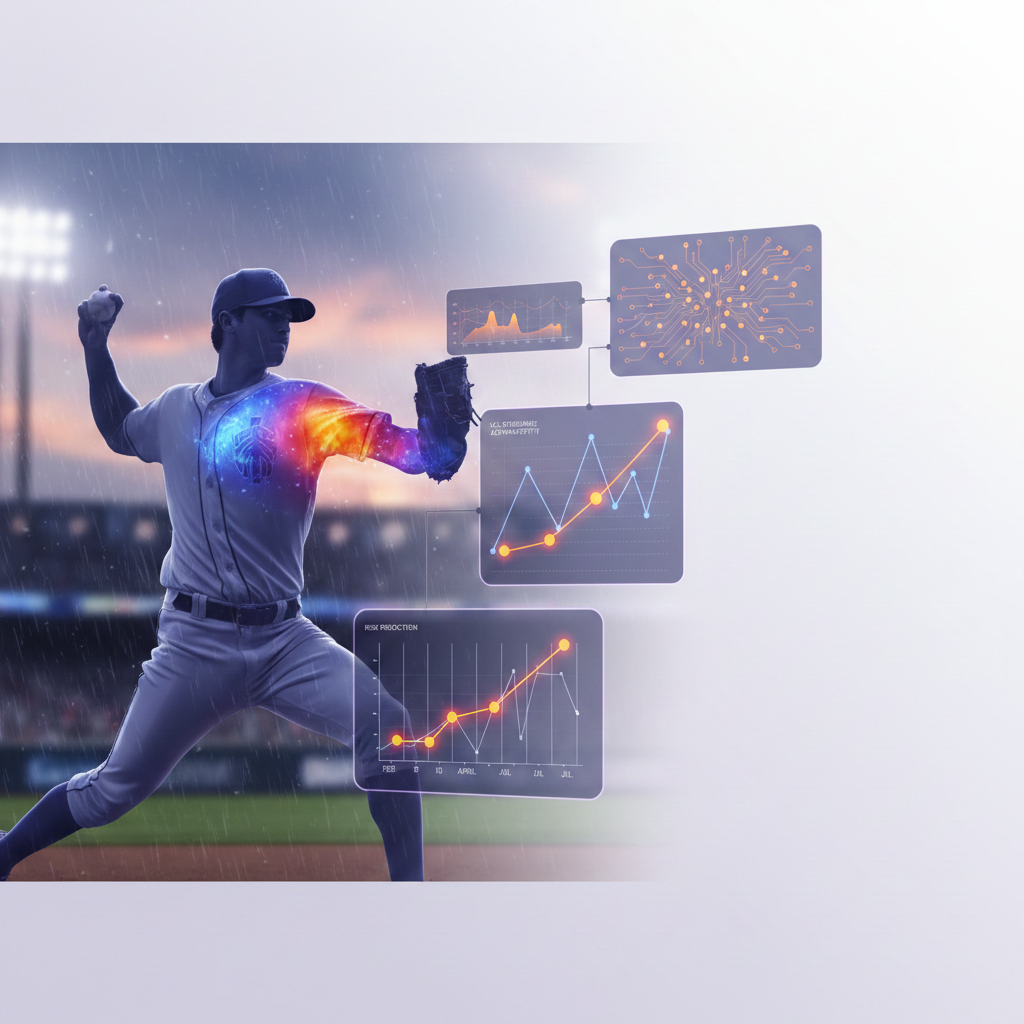
Every February, a familiar rhythm begins across baseball: pitchers and catchers report, bullpen sessions ramp up, and coaches start watching pitch counts. It is the most optimistic moment in the sport — the beginning of a new season, full of possibility. It is also the window in which UCL injuries are most likely to happen.
That is not speculation. It is what the data consistently shows. And yet, the tools most athletic trainers and team physicians rely on to catch these injuries early — subjective pain reports, functional testing, visual assessment of mechanics — are the same tools they have always used. Tools that, by design, activate only after the damage is already done.
This piece is about why that window exists, why it is so dangerous, and why objective thermal assessment may be the missing piece in early UCL injury prevention.
The Spring Surge Is Real, and the Numbers Are Clear
Research from Hospital for Special Surgery analyzing nearly 14,000 UCL injuries over three years found that spring months — March through June — account for the highest proportion of both injuries and surgeries. UCL injuries peak in April and May. The researchers' conclusion is direct:
"Athletes frequently experienced UCL injuries and surgeries in the early months of the baseball season. More emphasis should be paid to rehabilitative strategies at the beginning of a baseball season to help mitigate injury risk."
A separate analysis of nearly 9,000 UCL injuries over nine years found that spring months (March–May) account for 32.4% of all UCL injuries annually, with April alone representing 11.8% of yearly injuries.
Thirty-two percent of a year's injuries in three months. Nearly twelve percent in a single month.
This is not a distribution problem that better conditioning alone will fix. It is a structural vulnerability in how the throwing athlete transitions from off-season to competition — and it requires a structural solution.
Why Spring Is When the UCL Is Most Vulnerable
The explanation for the spring injury surge comes down to a mismatch: tissue that has been deconditioned by months of reduced throwing is suddenly asked to bear full competitive loads.
During the off-season, reduced throwing volume weakens the medial elbow stabilizers — primarily the UCL itself and the forearm flexor-pronator muscles (FPMs) that support it. When spring training begins, pitch counts and intensity rise quickly. The tissue has not yet completed the collagen remodeling necessary to handle those demands.
The UCL's vulnerability at this point is acute. Research by Hattori et al. (2021) found that after just 100 pitches, the UCL loosens significantly while the protective forearm muscles remain relatively stable. When the FPMs are not yet adequately conditioned, the UCL bears disproportionate stress — accelerating microtrauma in tissue that hasn't finished adapting.
Kinetic chain deficits compound the problem. Hip weakness, reduced shoulder mobility, and scapular dyskinesis alter throwing mechanics in ways that amplify elbow stress — even when the pitcher feels fine and reports no discomfort.
That last point is critical: feels fine, reports no discomfort. Traditional assessment depends on the athlete telling you something is wrong. But the cascade of stress, microtrauma, and tissue breakdown that leads to a UCL rupture begins long before pain announces itself. By the time the athlete says their elbow hurts, the window for early intervention may already be closed.
The Gap Between Symptoms and Tissue Reality
Pain is a late signal. This is not a controversial statement in sports medicine — it is broadly understood. But the clinical implications of that fact are not always reflected in how teams monitor pitchers during the spring ramp-up.
A morning conversation that goes "How does your elbow feel?" / "Fine" produces no actionable data. It confirms only that the athlete has not yet crossed the threshold into conscious pain — not that the tissue is healthy, adapting normally, or bearing stress symmetrically.
What happens between a healthy elbow in January and a torn UCL in April is a gradual process of accumulating microtrauma. The tissue sends signals throughout that process — metabolic signals, vascular signals, thermal signals — that are detectable at the surface of the skin long before the athlete reports pain. The challenge has been that no clinical workflow has made those signals easy to capture, standardize, and act on. Until now.
What Thermal Assessment Adds to the Clinical Picture
Infrared medical imaging detects asymmetric thermal patterns — differences in surface temperature between the throwing arm and the non-throwing arm, or between the same structure measured across sessions — that correlate with underlying tissue stress, inflammation, and incomplete recovery.
For a pitcher ramping up in February, serial thermal assessments can provide clinicians with a layer of objective data that subjective reporting cannot:
Asymmetric thermal elevation in the medial elbow may indicate that the UCL and surrounding tissues are bearing disproportionate stress during loading — a pattern that suggests the FPMs have not yet reached the conditioning level needed to protect the ligament.
Persistent thermal elevation across sessions may indicate that tissue is not recovering adequately between throwing days — a signal that load management intervention is warranted before symptoms appear.
Unexpected cooling patterns can point to compensatory mechanisms elsewhere in the kinetic chain — the body reducing load on a stressed structure by shifting mechanics in ways that may create secondary injury risk upstream or downstream.
None of these findings require the athlete to feel pain. None depend on subjective reporting. They are objective thermal data points that can be tracked, trended, and acted on within the athlete's normal monitoring workflow.
A Practical Model for the Spring Window
The February-to-April period presents a defined, predictable window of elevated risk. That makes it an ideal context for a structured thermal monitoring protocol:
Baseline assessment before the first throwing session — establishing individual bilateral symmetry norms for each pitcher, accounting for natural anatomical variation between the throwing and non-throwing arm.
Post-session assessments during progressive loading weeks — tracking how thermal patterns respond to increasing pitch counts and identifying when metabolic load exceeds recovery capacity.
Decision-support integration — using thermal pattern trends alongside existing monitoring tools (pitch count logs, velocity data, mechanical analysis) to inform load management decisions in real time.
This is not a replacement for clinical judgment. It is an additional data layer that allows that judgment to operate earlier in the injury cascade — when intervention is still most effective.
The Window Is Open Now
For college pitchers currently beginning pre-season workouts, and for major leaguers who will report to spring training in the coming weeks, the critical window has arrived. The tissue is deconditioned. The workload is accelerating. The injury peak is eight to ten weeks away.
The question is whether clinical teams will rely on the same tools that have produced the same injury rates, or whether objective thermal assessment can give them a meaningful earlier look at what is happening beneath the surface.
Earlier detection. Smarter intervention. Reduced downstream risk.
That is the goal of the critical window — to close it before it closes the season.
Vizbodx Inc. is developing AI-powered infrared medical imaging technology designed to detect asymmetric thermal patterns in sports medicine, occupational health, and senior care — often before symptoms emerge.
Recovery begins with discovery.
→ Read the original LinkedIn post → Learn more about Vizbodx
References
- Hospital for Special Surgery UCL injury database analysis (multi-year, ~14,000 injuries)
- Hospital for Special Surgery, 9-year analysis of UCL injury seasonality (~9,000 injuries)
- Hattori H, Akasaka K, Otsudo T, Hall T, Sakaguchi K. Ulnar Collateral Ligament Laxity After Repetitive Pitching: Associated Factors in High School Baseball Pitchers. Am J Sports Med. 2021 Apr 8.