A force plate will tell you that an athlete's jump symmetry is within acceptable range. A hop test will confirm that the injured limb is producing comparable output to the uninjured side. A functional movement screen will find no red flags.
And still, the athlete re-tears the ligament three weeks after returning to competition.
The tools said yes. The tissue said something else. The question is whether the clinical workflow was equipped to hear it.
What Force Symmetry Confirms — and What It Cannot
Force-based return-to-play assessments measure mechanical output: how much force the athlete generates, how symmetrically they distribute load, how well they perform sport-specific movement patterns under standardized conditions. These are legitimate, clinically important measures.
What they measure is performance at a point in time, under controlled conditions, in a clinical environment.
What they cannot measure is the physiological state of the tissue during that performance — whether the vascular response is symmetric, whether the metabolic demand is being distributed as expected, whether the nervous system's regulation of the recovering structures matches the load being applied.
This is not a failure of the assessments. It is a limitation of the domain they were designed to evaluate. Mechanical output and physiological readiness are related, but they are not the same thing. An athlete can produce acceptable force through a movement pattern while the underlying tissue is still managing a load that exceeds its recovery capacity.
Thermal concordance mapping addresses exactly this gap.
What Thermal Concordance Mapping Is
Thermal concordance mapping is the process of comparing infrared thermal data against a parallel mechanical or functional data set — and evaluating whether they tell the same story.
A concordant result is one in which the thermal profile and the functional assessment agree: the athlete produces symmetric mechanical output, and the thermal signature of both limbs is consistent with normal, symmetric physiological loading. The tissue is performing as expected, and the physiology supports it.
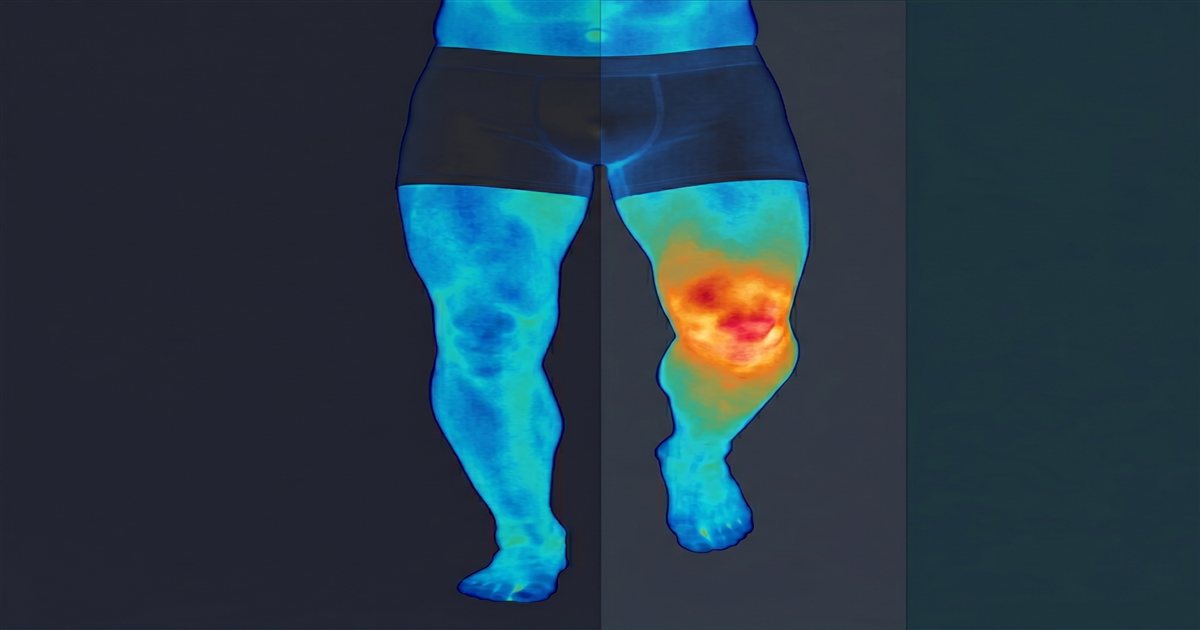
A discordant result is one in which the assessments diverge: the athlete achieves acceptable mechanical symmetry, but the thermal profile shows asymmetric patterns — one limb running hotter or cooler than expected, a joint demonstrating persistent thermal elevation in the absence of acute inflammation, or a recovery zone showing a delayed thermal normalization pattern after loading.
Discordance is a clinical signal. It is the tissue producing evidence that the mechanical assessment alone would not surface.
Why Discordance Matters More Than Either Metric Alone
Return-to-play decisions made on force data alone carry the limitation of a single-dimension assessment. The question being answered is: can this athlete produce the required output? The question not being answered is: is the physiological system managing that output safely?
Research from Frontiers in Physiology has confirmed that infrared thermography provides a complementary physiological layer to biomechanical assessment in sport: not replacing force metrics, but revealing vascular and metabolic patterns that force metrics cannot detect. ThermoHuman's applied research across elite sport environments has demonstrated that thermal asymmetry during rehabilitation correlates with tissue stress and recovery patterns in ways that functional testing alone does not capture.
Thermal concordance mapping integrates both data streams into a unified decision framework:
- Concordant (thermal and mechanical agree, both normal): return-to-play case is strong across both dimensions
- Concordant (thermal and mechanical agree, both abnormal): clear signal that return is premature
- Discordant (mechanical acceptable, thermal asymmetric): the most clinically significant scenario — and the one that force-only assessment misses entirely
The third case is where the thermal layer earns its clinical weight. The athlete appears ready by mechanical criteria. The physiological data says the tissue has not finished adapting. Returning the athlete in this state means asking tissue that is still actively managing load to bear the full demands of competition.
What a Thermal Concordance Protocol Looks Like in Practice
A practical thermal concordance workflow at the return-to-play stage integrates infrared assessment alongside functional testing rather than replacing it:
Pre-loading thermal baseline — capturing both limbs before functional testing begins, establishing the resting thermal profile for that session.
Post-loading thermal capture — imaging the athlete immediately following functional testing to observe how the tissue responds to the load imposed during assessment.
Bilateral thermal symmetry analysis — comparing the thermal response of the recovering limb to the contralateral limb, and against prior session baselines, to identify whether the response falls within expected parameters or shows asymmetric patterns.
Concordance evaluation — placing the thermal findings alongside the functional assessment results and evaluating whether they support the same conclusion about readiness.
When both dimensions point to the same answer, clinical confidence in that answer is higher. When they diverge, the divergence itself is the data — a prompt to investigate further before a clearance is given that the physiology does not yet support.
The Layer That Changes the Outcome
Return-to-play decisions are consequential. A premature clearance does not simply delay recovery — it risks a second injury that is statistically more severe, more surgically complex, and more likely to end an athlete's competitive career.
Adding a physiological layer to mechanical assessment does not eliminate that risk. But it narrows the blind spot. It means that when the tissue is producing evidence that the athlete is not yet ready, the clinical team has access to that evidence — not just the mechanical output that the tissue was able to generate on the day of testing.
Thermal concordance mapping is what happens when the question shifts from "what can this athlete do?" to "is this athlete's physiology ready for what they are about to be asked to do?"
Those are different questions. Both deserve an answer before the clearance is signed.
Vizbodx Inc. is developing AI-powered infrared medical imaging technology designed to detect asymmetric thermal patterns in sports medicine, musculoskeletal recovery, and occupational health — providing the physiological concordance layer that return-to-play protocols need.
Recovery begins with discovery.
→ Read the original LinkedIn post on thermal concordance mapping → Learn more about Vizbodx
References
- Arnaiz J, et al. Infrared thermography in sports medicine: a review. Br J Sports Med. 2012;46(5):376. https://bjsm.bmj.com/content/46/5/376
- Formenti D, et al. Thermal imaging of sports injuries. Frontiers in Physiology. 2023. https://www.frontiersin.org/journals/physiology
- ThermoHuman. Applied thermal imaging for elite sports return to play. ThermoHuman Research Series. https://thermohuman.com
- Hillen B, Pfirrmann D, Nägele M, Simon P. Infrared thermography in sports medicine. Int J Sports Med. 2020;41(1):1-5. https://www.ncbi.nlm.nih.gov/pmc/articles/PMC6942703/