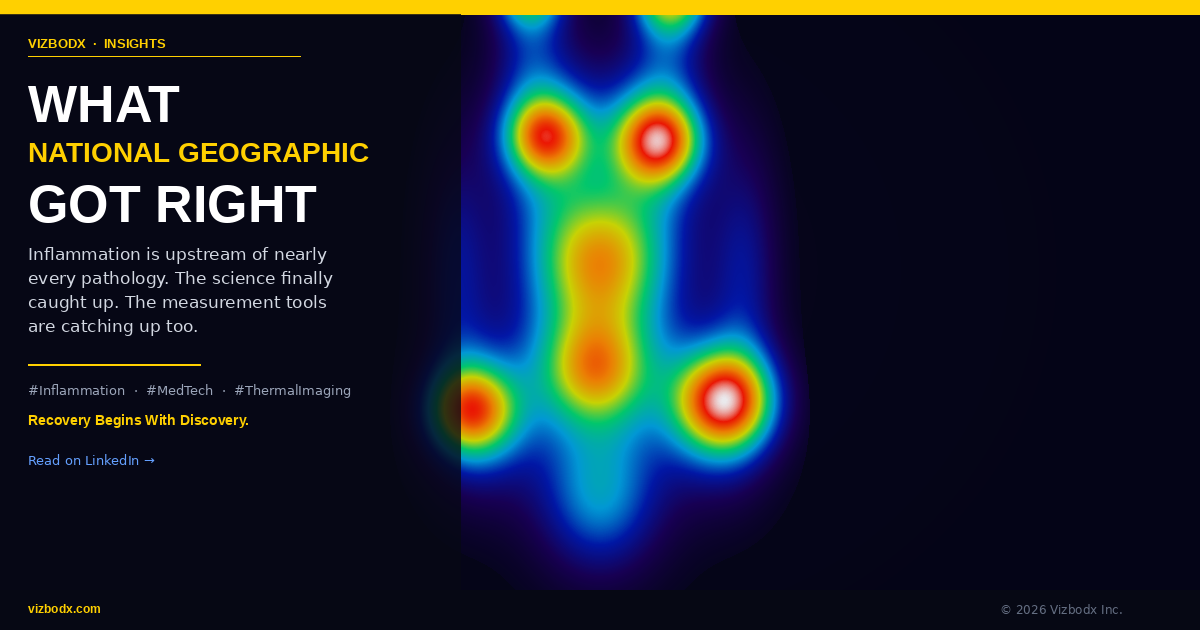
National Geographic recently ran a major feature on inflammation — a sign that public understanding of this biological process has finally caught up, at least partially, with clinical science. The coverage was thorough. It explained inflammation's dual role as both protector and destroyer, its relationship to chronic disease, and why researchers are increasingly focused on it as a master variable in human health.
This is good. The more accurately the public understands inflammation, the easier it becomes for clinicians to have meaningful conversations with patients, athletes, and institutions about prevention and early intervention.
But reading that coverage as someone working at the intersection of imaging technology and clinical practice, one thing stood out clearly: public awareness of inflammation has advanced significantly, while the clinical tools for measuring it in real time have not kept pace. That gap is worth talking about.
What We Know, and What We Can't See
The science on inflammation is, in many respects, well-settled. We know that it is upstream of nearly every major pathology. We know it operates on a spectrum from acute and beneficial to chronic and destructive. We know that the same biological process that repairs a torn muscle can, under the wrong conditions, accelerate joint degeneration, compromise cardiovascular health, and erode tissue over time.
What clinicians still struggle with — in practice, not in theory — is seeing inflammation in real time, at the tissue level, early enough to act on it.
The standard clinical picture relies on a combination of patient-reported symptoms, laboratory markers (CRP, IL-6, white cell count), imaging (MRI, ultrasound), and physical examination. Each of these tools has genuine value. None of them is particularly early, particularly accessible, or particularly suited to the kind of continuous monitoring that proactive inflammation management actually requires.
A blood panel gives you systemic markers — useful for confirming a diagnosis, not for catching a developing problem in a specific tissue before the athlete, worker, or patient feels it. An MRI gives you anatomical detail — exceptional resolution, but not a daily monitoring tool. Physical exam depends on what the clinician can see and feel, and on what the patient can accurately report.
What is missing from the standard toolkit is an objective, non-invasive method for continuously visualizing localized inflammatory activity — one that can be applied at the point of care, across a population, without requiring a specialist, a radiology suite, or a blood draw.
The Challenge Is Measurement, Not Awareness
This is where the public conversation about inflammation tends to stop. Awareness campaigns — even excellent ones like the National Geographic feature — are good at explaining what inflammation is and why it matters. They are less equipped to address the clinical reality of how you actually detect and monitor it in a way that informs treatment decisions.
The challenge for clinicians is not understanding the biology. The challenge is having tools that translate that biology into actionable, timely data.
In sports medicine, this gap shows up most acutely during periods of rapid load escalation — the pre-season ramp-up, the return-to-play window after injury, the final weeks of a competitive season when cumulative tissue stress is highest. Athletes push through pain. Coaches manage training loads based on volume and velocity. Clinicians assess based on what they can observe and what athletes disclose.
In occupational health, the gap looks different but the dynamic is similar. A worker developing cumulative soft-tissue stress in a high-repetition job does not typically report symptoms until the condition has progressed significantly. By then, the intervention is reactive rather than preventive, and the cost — to the worker and the employer — is substantially higher.
In senior care, the stakes shift again. Chronic low-grade inflammation is a significant predictor of functional decline, falls, and hospitalization. But the population least likely to accurately report subtle changes in how they feel is also the one for whom early detection would be most valuable.
Across all three contexts, the limiting factor is the same: there is no routine, scalable mechanism for visualizing localized inflammatory activity before symptoms become the primary signal.
What Thermal Imaging Adds to the Picture
Inflammation has a thermal signature. When immune cells mobilize, when blood flow increases, when metabolic activity elevates at an injured or stressed site — the surface temperature of the overlying skin changes in ways that are consistent, measurable, and detectable by calibrated infrared imaging systems.
This is not a new observation. Thermal imaging has been used in clinical research contexts for decades. What has changed — and what makes it relevant to the measurement problem described above — is the intersection of more sensitive imaging hardware, AI-powered pattern analysis, and the clinical workflow demands of sports medicine, occupational health, and senior care settings.
Objective visualization of thermal patterns does several things that conventional assessment cannot:
It is immediate — thermal changes appear within minutes of tissue stress, not days after symptoms emerge.
It is objective — the data does not depend on patient self-report or clinician interpretation of vague complaints.
It is comparative — bilateral asymmetry analysis provides a baseline reference point that makes individual variation interpretable rather than confounding.
And it is continuous — unlike a blood panel or MRI, thermal assessment can be integrated into routine monitoring workflows without significant burden to the patient or the clinical team.
This does not replace laboratory markers, imaging, or clinical examination. It adds a layer of information that those tools currently cannot provide: a non-invasive window into localized tissue activity that is early enough to be actionable.
What National Geographic Got Right
The framing of inflammation as a central variable in human health is correct. The emphasis on its dual nature — beneficial when acute and appropriately resolved, destructive when chronic or dysregulated — is accurate. The broader public understanding that inflammation is upstream of most major disease processes is a genuine step forward in health literacy.
What would make that awareness clinically useful, at scale, is a corresponding advance in how inflammation is monitored in the people who need monitoring most: athletes in high-load training environments, workers in high-repetition occupational settings, older adults managing the slow accumulation of inflammatory risk.
The awareness is there. The measurement tools are catching up.
Vizbodx Inc. is developing AI-powered infrared medical imaging technology designed to detect asymmetric thermal patterns in sports medicine, occupational health, and senior care — often before symptoms emerge.
Recovery begins with discovery.
→ Read the original LinkedIn post → Learn more about Vizbodx