Ninety percent.
That is the Limb Symmetry Index threshold that has become the de facto clearance standard for return to sport after ACL reconstruction. If the injured limb tests at ninety percent of the uninjured limb's strength or hop distance, the athlete is cleared. The score says they are ready. The season can resume.
What the score does not say — and cannot say — is whether either limb is actually healthy.
What the Limb Symmetry Index Measures, and What It Misses
The Limb Symmetry Index is a ratio. It compares the injured limb's performance to the uninjured limb's performance. The logic seems sound: if the reconstructed knee produces ninety percent of what the other knee produces, recovery is nearly complete.
The problem is the denominator.
Research has consistently documented that ACL reconstruction does not damage only the operated knee. The contralateral limb — the "healthy" reference leg — undergoes measurable functional decline during the post-operative period. The athlete compensates, favors the uninjured side, and the uninjured side weakens in response to the altered loading patterns.
A 2021 MDPI study confirmed bilateral limb deficits following ACLR, showing that many athletes who achieve ≥90% LSI still fail to meet normative population benchmarks for their sport. The Journal of Orthopaedic & Sports Physical Therapy has published similar findings: athletes cleared by LSI criteria frequently test below their own pre-injury functional capacity when that baseline is used as the reference rather than the contralateral limb.
This is the LSI trap. When both limbs are weaker than they should be, comparing them to each other produces a symmetry score that looks like success. The athlete clears the threshold. The tissue has not actually recovered to a level that matches the demands of competition.
The Cost of a False Clearance
The downstream consequence of the LSI trap is not abstract.
Athletes who return to sport without achieving true functional capacity — as opposed to bilateral symmetry — carry elevated reinjury risk. ACL reinjury rates remain stubbornly high: multiple prospective studies have placed secondary ACL injury risk at 15–25% in young athletes who return to pivoting sports. Some high-exposure populations exceed that range.
The athletes who experience reinjury are not failing because their symmetry scores were wrong. They are failing because symmetry scores answer a different question than readiness.
Symmetry asks: is the injured limb similar to the reference limb?
Readiness asks: is the athlete physiologically capable of tolerating the demands of competition without accumulating tissue damage faster than recovery can manage it?
These are not the same question.
What Thermal Assessment Sees That Force Metrics Cannot
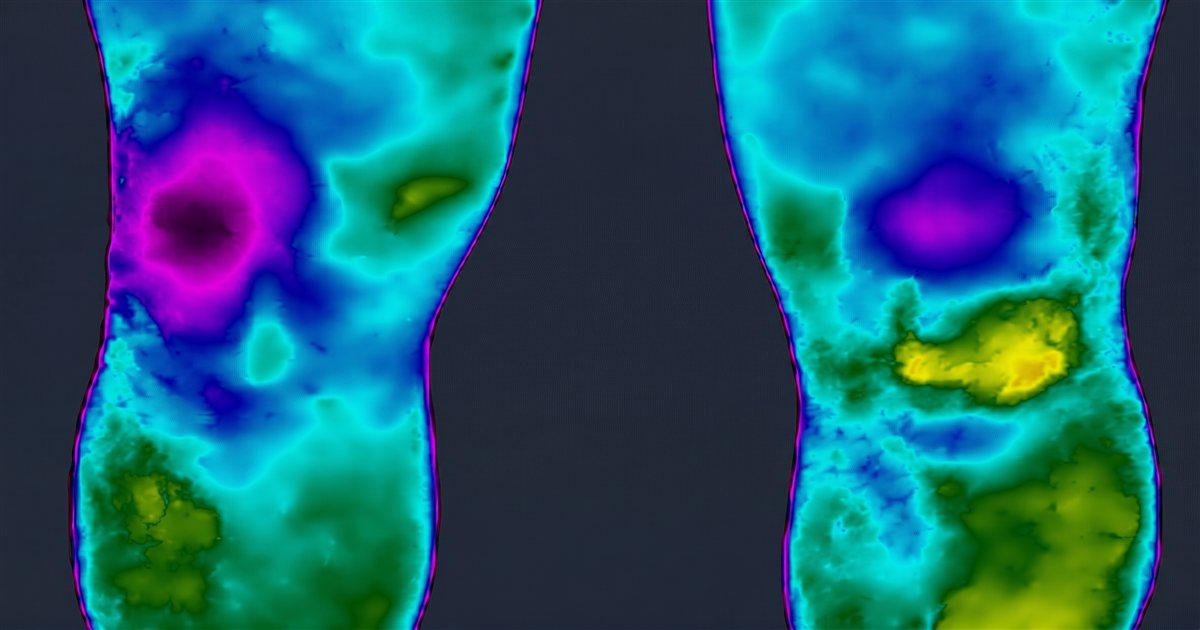
Infrared thermal imaging detects surface temperature patterns that reflect underlying vascular and metabolic activity. In the context of ACL rehabilitation, this creates a window into tissue behavior that force-based assessments do not provide.
Thermal asymmetry in the reconstructed knee that persists well into rehabilitation — beyond the acute inflammatory phase — may indicate that the tissue is still under disproportionate physiological stress during loading. The knee is working harder than the thermal profile of a recovered joint would predict.
Compensatory thermal patterns in the contralateral limb can reveal overloading that the athlete is not consciously aware of. When the uninjured side is bearing excessive load due to movement compensation, it produces a detectable thermal signature before functional testing captures the deficit.
Bilateral thermal baselines provide a pre-injury reference point that the LSI cannot: not how one limb compares to the other today, but how both limbs compare to their own prior states — a physiological record of where the athlete started, not just where they are relative to a weakened benchmark.
None of these signals require the athlete to report symptoms. None of them depend on pain as the alert mechanism. They are physiological data, available throughout the rehabilitation process, that can flag when the tissue is not ready even when the symmetry score says otherwise.
A More Complete Return-to-Sport Framework
The goal is not to replace the Limb Symmetry Index. It is to understand what it cannot see.
A return-to-sport framework that integrates thermal monitoring alongside standard functional testing adds a physiological layer to decisions that are currently made on mechanical grounds alone. When the force data and the thermal data agree — the reconstructed knee is strong, the thermal profile is symmetric and calm, the compensatory pattern has resolved — the case for return is stronger. When they diverge — the symmetry score clears the athlete but the thermal profile still shows asymmetric loading signatures — that divergence is a signal worth investigating before the clearance is given.
The LSI trap closes when clinicians have access to more than one dimension of recovery. Mechanical symmetry is one dimension. Physiological symmetry is another. Athletes deserve assessment that addresses both.
Vizbodx Inc. is developing AI-powered infrared medical imaging technology designed to detect asymmetric thermal patterns in sports medicine, musculoskeletal recovery, and occupational health — providing the physiological layer that force metrics cannot.
Recovery begins with discovery.
→ Read the original Vizbodx LinkedIn post → Learn more about Vizbodx
References
- Bodkin SG, Hertel J, Hart JM. Functional performance deficits identified at time of return-to-sport following ACL reconstruction. Int J Sports Phys Ther. 2021.
- Grindem H, et al. Simple decision rules can reduce reinjury risk by 84% after ACL reconstruction: the Delaware-Oslo ACL cohort study. Br J Sports Med. 2016;50(13):804-808.
- Paterno MV, et al. Biomechanical measures during landing and postural stability predict second anterior cruciate ligament injury after anterior cruciate ligament reconstruction and return to sport. Am J Sports Med. 2010;38(10):1968-1978. https://pubmed.ncbi.nlm.nih.gov/20508077/
- Ithurburn MP, et al. Young athletes after anterior cruciate ligament reconstruction with single-leg assessment asymmetries at the time of return-to-sport demonstrate decreased knee function 2 years later. Am J Sports Med. 2017. https://journals.sagepub.com/doi/10.1177/0363546517708996
- ThermoHuman. Infrared thermography in ACL rehabilitation monitoring. ThermoHuman Research Series, 2024. https://thermohuman.com