
Twenty-seven radiologists sat down to read fifty mammograms with an artificial intelligence assistant at their side. For most of the cases, the assistant was right. For twelve of them, it was deliberately wrong.
When the assistant was wrong, the least experienced readers were right less than one time in five. The readers with more than fifteen years of experience, the people every department relies on to catch what others miss, were right 45.5 percent of the time. Reading the same images without a bad suggestion, that group scored 82 percent.
Nobody in that room became a worse radiologist between one case and the next. Something else changed. The machine spoke first.
The Problem Has a Name, and It Is Older Than the Software
The tendency to accept an automated suggestion over one's own judgment is called automation bias. It was described in aviation cockpits long before it reached the reading room, and it has been documented in clinical decision support for two decades.
A 2012 systematic review in the Journal of the American Medical Informatics Association screened 13,821 papers and included 74 studies of the phenomenon in healthcare. Its authors found that automation bias grows with workload, time pressure and task complexity, and that it is shaped by how much the user trusts the system and how the advice is presented on screen.
The mammography study, published in Radiology in 2023, added the detail that matters most for any new imaging modality. Experience did not protect anyone. It only changed the size of the loss.
That finding should unsettle every field where AI is arriving faster than training. Clinical infrared imaging is one of those fields.
Why Thermal Imaging Is Especially Exposed
A thermogram is a color map of skin temperature, and it is built to be read visually. Asymmetries jump out. Warm regions glow. A software overlay that circles a region and attaches a probability is, from the reader's point of view, just another vivid layer on an already vivid image.
That is the first exposure: the modality invites fast pattern recognition, which is exactly the cognitive mode in which anchoring works best.
The second exposure is the learning curve. Most clinicians adopting infrared imaging today are early in their experience with it. The Radiology data are unambiguous about who suffers most when a confident suggestion is wrong: the readers who have seen the fewest cases. An AI layer presented before the clinician has formed an impression does not shorten that learning curve. It can quietly replace it.
The third exposure is regulatory. Medical thermography is an adjunct to clinical judgment. It provides objective physiological data that supports assessment. It does not diagnose. A workflow that trains the clinician to wait for the algorithm's verdict is moving in the opposite direction from that posture.
The Variable Nobody Puts on the Spec Sheet
Ask a software team how AI enters the clinical encounter and the answer is usually about latency: how quickly the result appears. The evidence points to a different variable. Not how fast, but when relative to the clinician's own judgment.
A 2026 reader study in European Radiology tested this directly. Six breast radiologists, stratified by experience, read 200 mammograms under three conditions: unassisted, with an AI recommendation, and with an AI recommendation plus a heatmap explaining where the model was looking. In 30 percent of cases, the AI's category had been deliberately shifted by one step.
Without explanations, readers anchored on the misleading suggestion in 33.9 percent of manipulated cases. With the explanation visible, anchoring fell to 17.2 percent. The least experienced readers anchored most often (38.3 percent), the most experienced least often (28.3 percent), and none of them were immune.
The message is consistent with the 2012 review's list of mitigators: where the advice sits on screen, whether it comes with a confidence indicator, whether it is framed as information rather than a recommendation, and whether the user is held accountable for their own call. These are design decisions. Every one of them is made before a clinician ever opens the software.
What "Clinician First" Actually Means
There is a simple sequencing rule that follows from all of this. The clinician looks first. The clinician records what they see. Then, and only then, the algorithm is allowed to speak.
In practice, that sequence has three parts.
Independent assessment. The clinician reviews the thermal image, notes the regions that concern them, and records an impression. The software does not show any AI output during this phase, not grayed out, not collapsed, not as a hint.
Explicit clinical action. The clinician commits to a judgment in a way the system records. This is the step most workflows skip, and it is the one the 2012 review identifies as a mitigator: accountability for one's own decision reduces reliance on the machine's.
AI as a second reader. The algorithm's analysis appears after the commitment, positioned as a comparison, not a correction. Where the two disagree, the disagreement is the clinically interesting event. It prompts a second look rather than a silent override.
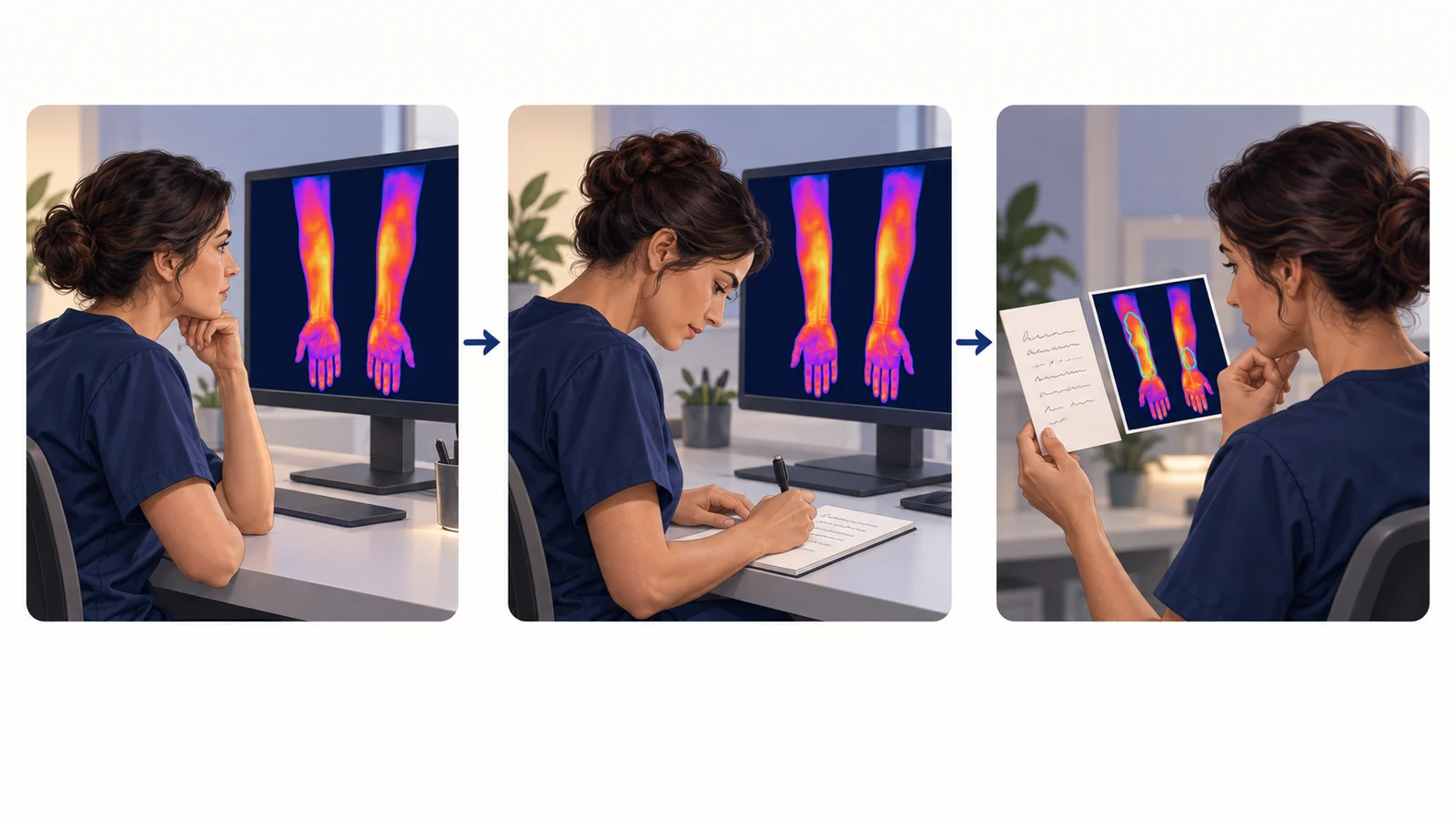
Conceptual workflow: the clinician reviews and records an independent assessment before AI appears as a second reader. Disagreement prompts another look.
Radiology has begun testing the same idea under the name "post-read" implementation. In a 2025 study of AI for intracranial hemorrhage on CT, one advantage the authors noted for showing AI output after the radiologist's read was that the reader remained blinded to the model's decision, so the AI could flag potential misses and overcalls for re-review instead of steering the initial interpretation.
What the Numbers Add Up To
Placed side by side, the three studies describe one mechanism from three angles.
- The harm scales with inexperience and with confidence. In the 2023 Radiology study, the readers who lost most were those with the fewest cases behind them, and the misleading suggestions were presented with exactly the same authority as the correct ones.
- The mitigation scales with presentation. In the 2026 European Radiology study, showing the model's reasoning did more than halve anchoring: it lifted overall reader accuracy from 86.2 to 90.1 percent.
- The mechanism is old and general. The 2012 JAMIA review found the same bias across prescribing support, computer-aided detection in screening and automated electrocardiogram interpretation, long before deep learning reached medical imaging.
None of these studies were about thermography. That is the point. Automation bias is a property of human readers interacting with confident machines, and it travels with the reader into any modality they pick up.
How Vizbodx Sequences the Encounter
Vizbodx has built its platform around this sequence and has described the architecture publicly as Clinician-First AI. In June 2026 the company announced its Clinician-First AI Clinical Workflow patent filing, first lodged as a provisional application in March 2026, covering a clinical workflow in which the clinician must independently assess the thermal image and record a judgment before any AI analysis is presented.
Barry Hix, Vizbodx co-founder and CEO, put the rationale plainly in that announcement: "A growing body of peer-reviewed research confirms that automation bias affects clinicians at all expertise levels. The timing of AI output presentation is a material factor in clinical decision quality." Co-founder and CTO Mayco Anderson Moreira added that "AI must demand the clinician's own judgment," and described a design in which "engaged assessment and early interpretation is required by the architecture, not just encouraged."
The second half of the design is about what the AI is allowed to do once it does speak. In September 2026 the company filed a third application, this one for proposing region-of-interest placement from anatomical landmarks so that bilateral and longitudinal temperature comparisons are drawn on corresponding anatomy rather than on hand-placed pixels. The clinician confirms, adjusts or rejects every proposed region before a measurement is recorded.
The division of labor is deliberate. The algorithm takes on the repetitive geometry: finding the matching region on the other limb, or the same region in last month's image. The clinician keeps the interpretation. Announcing the September filing, Hix reduced the principle to one line: "AI should sharpen clinical judgment, not substitute for it."
Vizbodx Academy, launched in August 2026, exists to support the human half of that equation. Its curriculum begins with the science of infrared imaging and progresses to interpretation within the broader clinical context, because a clinician-first workflow only works when the clinician's first read is a trained one.
What Changes When the Order Changes
Sequencing AI after the clinician does not make the algorithm less useful. It changes what the algorithm is useful for.
Shown first, an AI output is an anchor. The clinician's task becomes agreeing or disagreeing with it, and the evidence says disagreement is rarer than it should be. Shown second, the same output becomes a check. Concordance between the clinician and the model raises confidence in a finding. Discordance flags the cases that deserve more time. Either way, the clinician has already done the cognitive work that makes their judgment worth having.
For a modality that reveals physiological signals before symptoms appear, that ordering matters more, not less. Thermal asymmetry is subtle. The value of infrared imaging is a clinician who has learned to see it, supported by software that helps them see more, not one who has learned to wait for a colored box.
The body sends its signals in a particular order: physiology first, symptoms later. Clinical software should respect an order too. Clinician first, AI second.
Recovery begins with discovery. Discovery begins with the clinician's own eyes.
Vizbodx Inc. is developing AI-powered infrared medical imaging technology designed to detect asymmetric thermal patterns in sports medicine, occupational health and musculoskeletal recovery, often before symptoms emerge. Vizbodx software is an adjunct to clinical judgment; it does not diagnose.
Recovery begins with discovery.
→ Read the LinkedIn post where Vizbodx describes its clinician-first approach → Learn more about Vizbodx
References
- Dratsch T, Chen X, Rezazade Mehrizi M, et al. Automation Bias in Mammography: The Impact of Artificial Intelligence BI-RADS Suggestions on Reader Performance. Radiology. 2023. https://pubs.rsna.org/doi/full/10.1148/radiol.222176
- RSNA. AI Bias May Impair Radiologist Accuracy on Mammograms. May 2023. https://www.rsna.org/news/2023/may/ai-bias-may-impair-accuracy
- Goddard K, Roudsari A, Wyatt JC. Automation bias: a systematic review of frequency, effect mediators, and mitigators. J Am Med Inform Assoc. 2012;19(1):121-127. https://academic.oup.com/jamia/article-abstract/19/1/121/732254
- Pesapane F, et al. Evaluating cognitive biases in AI-assisted mammography interpretation: a simulation reader study of explainable AI across radiologist experience levels. European Radiology. 2026;36:7639-7650. https://link.springer.com/article/10.1007/s00330-026-12666-6
- Impact of a computed tomography-based artificial intelligence software on radiologists' workflow for detecting acute intracranial hemorrhage. 2025. https://pmc.ncbi.nlm.nih.gov/articles/PMC12417916/
- Vizbodx Inc. Vizbodx Files Clinician-First AI Clinical Workflow Patent. PR Newswire, June 9, 2026. https://finance.yahoo.com/sectors/healthcare/articles/vizbodx-files-clinician-first-ai-130700363.html
- Vizbodx Inc. Vizbodx Expands Clinician-First AI Architecture with Third Patent Filing. PR Newswire, September 14, 2026. https://www.prnewswire.com/news-releases/vizbodx-expands-clinician-first-ai-architecture-with-third-patent-filing-302878061.html
- Vizbodx Inc. Vizbodx Inc. Launches Academy to Establish a New Educational Standard for Clinical Infrared Imaging. PR Newswire, August 4, 2026. https://www.prnewswire.com/news-releases/vizbodx-inc-launches-academy-to-establish-a-new-educational-standard-for-clinical-infrared-imaging-302842536.html